Monday, August 2, 2010

Rising Moon

After years of looking at the Moon and photographing it for the past few, I still have to admit that it is one of my favorite night sky objects. Even though when it is up it washes out a good portion of the other objects, I never get tired of looking at it. I finally had the chance to catch a wonderful event - a full Moon rising from the horizon when it was large and orange.

I went out on July 24, 2010 with my good friend Bob of Blackholes and astrostuff fame. We were on time and set up and ready to go, but where the heck was the Moon? Our Moon phase info was accurate and we knew it was up, but what in the world was going on? It turns out that for one, there was a lot of forest-fire smoke in the sky above the horizon where we were looking for the Moon. The next problem is that we were out in our calculation of where it would be rising. So, by the time we noticed it, it had risen a couple of Moon widths from the horizon. No worries though, all turned out well and we were able to catch some decent shots.

The next night, July 25, 2010, we were both out at separate locations shooting the Moon again. It was cloudy in the area it was rising, but alas, the clouds dissipated and the Moon was out in full force. It was huge to say the least and looked amazing. I wish I had my telescope with me that night to take some Moon pictures through that, but I didn't. No problem. I managed to get some shots I was very happy with. Below are photos from both evenings. All were shot using a tripod-mounted Nikon D90 with a 70-300mm f/4-5.6 lens and a 1.5x teleconverter, with a remote shutter release. Enjoy.


Wednesday, June 30, 2010

Firm hopes method resonates with mining industry

Below is a link to a Star Phoenix article about Leaf and Stone. The guys who own the company, Robert Fisher and Murray McArthur are two smart guys who I consider friends. We're working together on a project and I am excited to be a part of it. I've also included the text of the story, in case the link on the Star Phoenix site ever changes.

Firm hopes method resonates with mining industry

"Firm hopes method resonates with mining industry Satellite-based data analysis touted for exploration

By Cassandra Kyle, The StarPhoenix - June 30, 2010

As the old saying goes, if something is too good to be true it usually is.

It's an adage Saskatoon businessperson Robert Fisher, CEO of Leaf and Stone Resonance Services Ltd. (L&S) is fighting against as he tries to spread the word about a new type of mineral exploration technology that uses satellite-based data analysis to locate Mother Nature's hidden resources.

"Give us a sample and we'll find the match -- it doesn't really matter what you're looking for," Fisher said in a recent interview.

"What we're really doing is we're taking a physics and a mathematical solution to a geological problem."

Using resonance coupling technology, a method developed by his Austin, Texas-based friend and business partner David Carr, the company surveys a client's property via satellite looking for a match to the sample substance provided. So far the technology, which is licensed to Carr's company Natural Resource Testing LLC, has found oil, gas, gold, diamonds and several other natural substances using the unique method.

Clients have been satisfied with the resonance coupling results, but it has been difficult for L&S, which acts as the marketing agent for the technology, to convince long-serving mining industry executives to give the technology a try.

"No one believes us. It's been our biggest issue," said Fisher, a longtime Saskatoon resident who used to work in the heath-care software industry.

"We say we have great credibility, but I'm sure to geologists and geophysicists we have none. . . . But it's just a matter of time -- 30 clients are now 40 and it's growing."

In a nondescript office in downtown Saskatoon, Fisher presents evidence of the technology's accuracy: Maps showing the resonance coupling picking up the gold vein between Red Lake and Madsen, Ont.; notes of thanks, including one praising the company for informing a client the actual location of its gold deposit was really 30 metres in the opposite direction and a letter of reference from an oil and gas company praising the veracity of the exploration method.

Resonance coupling, Fisher explained, isn't supposed to replace traditional mineral exploration methods. Based on the physics principle that every substance on earth has a unique resonance signal, the technology can focus in on where deposits are located, increasing accuracy and reducing needless drilling.

"Is saves you money, which is the big name in exploration," he said.

With the industry naturally skeptical of new technology -- especially one such as resonance coupling -- Fisher understands any acceptance of the unique exploration system will take time.

Still, with a sales office recently opening in Australia and the company recording its first repeat customer just last week, Fisher remains positive about the applications of the technology he believes is worth billions of dollars.

"I truly believe that is the battle; we need to just convert people," he said.

ckyle@sp.canwest.com

© Copyright (c) The StarPhoenix"

Sunday, June 20, 2010

RASC - Saskatoon Centre New Members Night

After a far-too long absence, mainly due to such horrible weather for most of the past few months, I finally have a new post. At a local meeting of our astronomy club (RASC - Saskatoon Centre), I had suggested we have a new members night as a way to get new people out and have some experienced astronomers share their knowledge. As a new(er) member myself, I thought this would be a good idea since there is much I need to learn about astronomy in general.

We met at the University of Saskatchewan Observatory on June 17th. It was organized mainly by Patricia G (thanks for that). Local members Richard Huziak and Mike Clancy spoke to us. Rick talked about choosing telescopes, eyepieces and binoculars, etc. while Mike spoke about the Explore the Universe certificate program offered by the RASC. There were about 10 people who were out to listen to the talks, which were both enjoyable, informative and entertaining. Thanks to Rick and Mike for speaking.

Below are some images of the talk itself and of the observatory. The observatory has been a fixture on the U of S campus for many years. It houses a 6-inch telescope. For more info on the observatory, visit this link.

Rick Huziak talking telescopes

Mike Clancy showing a star chart

U of S Observatory

6-inch telescope

Meteorite collection

Copies of the first star charts and such

Copy of Galileo's notes

Old telescope

Tuesday, April 13, 2010

Northern Lights In the North (Sort Of)

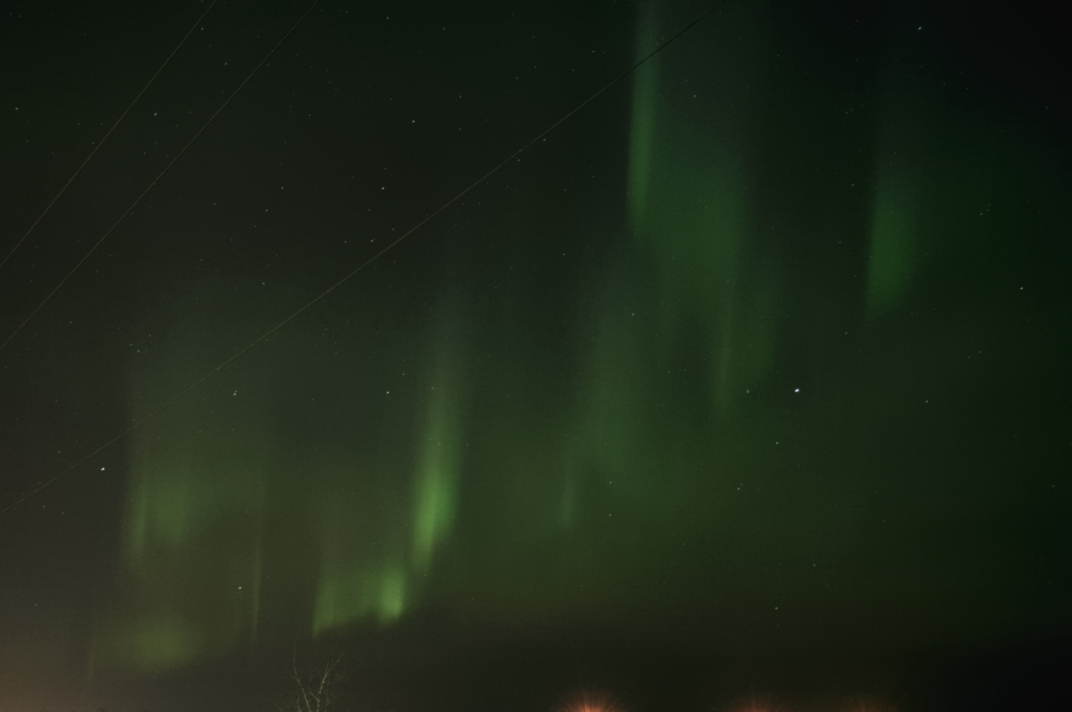
I had the chance to finally capture some Northern Lights (Aurora Borealis) on April 5, 2010. I was out with my good friend Bob of Blackholes and Astrostuff and went just outside the city limits to catch them. They didn't last too long, so we had to work fast. For my first time photographing them, I was pleasantly surprised with the results. At first, I was skeptical about how the shots would turn out, because I was using my Nikon D90, which is notoriously bad for the level of noise it introduces into night shots. But, with a little tweaking using my software, I was able to get the shots looking half-decent.

Aurora's are basically the emission of photons in Earth's upper atmosphere. For a more detailed description, please click here. I can try to explain it but I'm not a science-type guy and therefore wouldn't do it justice. Also, in the title, I have sort of in brackets. The reason for that is because while we may be fairly north of some places that can see the Northern Lights, we are not far enough to see the amazing ones that are seen in the Arctic. They still look pretty awesome.

And a special thanks to Planetaryman (my Dad) for being my newest follower.

Enjoy the photos. And hopefully, Blogger won't butcher them too much this time.


Wednesday, March 24, 2010

Earth Hour In Saskatoon

The theme this year at the Centre Mall in Saskatoon for Earth Hour is "Go Celestial". Saturday, March 27, 8:30-9:30pm at the entrance by Tony Tomas is the place to be during Earth Hour. Here is a link to the Earth Hour Canada site.

Earth Hour was started in 2007 in Sydney, Australia when over 2 million homes turned off their lights for one hour to bring awareness to climate change. In 2008, over 50 million people in 35 countries participated and in 2009, more than 88 countries took part. 2010 is sure to be even bigger.

Last year in Saskatoon, there was a large line-up of people at the Centre Mall, so this year only promises to be bigger (weather providing of course). I plan on being there for this event, as does Bob of Blackholes and Astrostuff. The Royal Astronomical Society of Canada Saskatoon Centre will be setup as well with telescopes set up. But Bob cautions everyone to maybe be there about 30 mins ahead of time to setup your scopes before viewing starts.

The first link below is to the page on the mall site about the event. It's the second from the bottom. The last link is the flyer the mall has put together for this event.

Centre Mall events

Centre Mall flyer

Hope to see you out

Earth Hour - Logo

Tuesday, March 23, 2010

Zodiacal Lights (and Casino Lights)

On March 6, 2010, I went out with Bob of Blackholes and Astrostuff to photograph the Zodiacal Lights. Zodiacal light is caused by sunlight reflecting off of dust particles in the solar system known as cosmic dust, known as the interplanetary dust cloud. It usually appears as a triangle-shaped column of light in the western sky in the spring just after the evening twilight has disappeared, or in autumn just before morning twilight appears.


The following picture is one that was taken the same night as the ones above. It is of our local Dakota Dunes Casino lights shining into the sky causing light pollution. Unfortunately, the casino operators have no respect for astronomy nor care that the light pollution is a problem. Thus, the lights persist night after night. Orion constellation is in the center, The Hyades are up and to the right of that and the Pleiades are in the top right corner.

Friday, February 26, 2010

And Now For Something Completely Different

I was in Lethbridge, AB this past week and noticed that the Moon was up during the day. There is a neat looking bridge there called the High Level Bridge. It is used by trains to cross a large valley. It is the largest of it's kind in the world. I've been wanting to photograph it for some time now and finally had the chance. I went out on a day when there was little cloud cover and the Moon was visible during the day.

It also gave me a good chance to finally use my Canon 40D. I will be posting pictures taken with the Canon soon, but for now, here are the photos taken with my Nikon D90.


Monday, February 8, 2010

Sundog Days of Winter

"Dazzle mine eyes, or do I see three suns?"
Shakespeare - Henry VI, Part 3

The word sun dog (or sundog) originates from the Greek word parēlion, meaning "beside the sun". The scientific name is parhelion, plural parhelia. It's essentially a phenomenon in the atmosphere formed by plate shaped hexagonal ice crystals (in high and cold cirrus clouds) that create bright spots of light, often a luminous ring (or halo), on either side of the Sun. The ice crystals are called diamond dust and drift in the air at a low level. Sundogs orrur when the Sun is at a 45 degree angle and is at its lowest point. Sundogs may appear as a colored patch of light, typically displaying the colors of the rainbow (red closest to the Sun, with orange then blue farthest out) to the left or right of the sun at the same distance above the horizon as the sun. They can be seen anywhere in the world during any season, but they are not always obvious or bright. Here in Canada, they are most prevalent during the winter months when the air is coldest and more ice crystals are in the sky.

Below is the first-ever photo of a sundog taken be myself in January 2010.

Friday, January 29, 2010

Perigee Moon and Mars

Finally, I've been able to put up a new post after a two month hiatus. By hiatus I mean cloudy, snowy and cold weather interfering with my picture taking and observing with the telescope. However, I am happy to report that I was able to snap the perigee Moon last night and Mars. It was the first time I've ever seen Mars through the lens of my camera. I'm hoping it will warm up a little so I can observe it through my scope.


Saturday, November 7, 2009

Cool November Nights

Even though October was a complete waste as far as the night sky went where I live, I was finally able to get out with my telescope tonight. Even though it's only 4.5" in diameter, I was able to see some things I never have before. It was quite exciting. And this was in-the-city viewing, with all of the light pollution we have too. So, I was able to see the Andromeda Galaxy (M31), the Orion Nebula (M42 and 43), Hyades (in Taurus) which was really awesome, the double cluster in Perseus consisting of NGC 869 and NGC 844 (which was awesome), and a few others. I did try to photograph them, but to no avail. So, now for some info on what I was able to see.

The Andromeda Galaxy
This particular galaxy is probably the most famous in the night sky. It is bright enough, at magnitude 4.4, to be seen with the naked eye. It is also known as M31 (or Messier 31) and NGC 224. This galaxy is like our own Milky Way in that it is a spiral galaxy believed to be similar in mass. It is located approximately 2,500,000 light years away and is found at Right ascension 00h 42m 44.3s, Declination +41° 16′ 9″[1].

Photo courtesy of NASA

The Orion Nebula
This nebula is also known as M42 or NGC 1976. It is referred to as a diffuse nebula (and contains mostly ionized hydrogen) and is located just below Orion's Belt at Right ascension 05h 35m 17.3s, Declination -05° 23′ 28″. At an apparent magnitude of +3.0, it is visible to the naked eye and is approximately 1,344 light years away. The Nebula is part of a much larger nebula known as the Orion Molecular Cloud Complex. This Complex extends throughout the constellation of Orion and includes Barnard's Loop, the Horsehead Nebula, M43, M78 and the Flame Nebula. Stars are forming throughout the Orion Nebula, and due to this heat-intensive process the region is particularly prominent in the infrared.

Photo courtesy of Wikipedia.org
The Hyades
I have never seen this before tonight. I thought it was really neat. I found it by accident. I had been looking for Orion and the Pleiades. Almost in between them, I could see a fuzzy patch, so I pointed my scope at it and saw this open cluster. It is classed as an open cluster because the stars are not as tightly bound by gravity as they are in a globular cluster. It consists of a roughly spherical group of 300 to 400 stars that share the same age, place of origin, chemical content, and motion through space. Hyades is approximately 151 light years away and can be found at Right ascension 04h 27m, Declination +15° 52′. The Hyades Cluster, at apparent magnitude 0.5, lies in the constellation Taurus, where its brightest stars form a rough "V" shape along with the still brighter red giant Aldebaran. Contrary to how it appears, Aldebaran is completely unrelated to the Hyades, as it is located much closer to Earth and merely happens to lie along the same line of sight.

Photo courtesy of SEDS
Perseus Double Cluster
These two open clusters are known as NGC 884 and NGC 869 (or more commonly known as the Double Cluster). They are visible to the naked eye and lie in the constellation Perseus, below Cassiopeia. NGC 884 is approximately 7600 light years away with NGC 869 being about 6800 light years away. They can be found at Right ascension 2h 20m, Declination 57° 08′. In the photo below, NGC 884 is the on the left and NGC 869 on the right. It is said they have blueshifted as well, which is a method of determining their distance using light wavelengths, etc. They are traveling toward Earth at approximately 22km/s.

Photo courtesy www.astrophoto.net